

Building wealth is not just about how much you earn. It is about what happens to your money after payday. A higher income creates possibilities, but it does not automatically create security, investments, or freedom. Without a clear plan, even a good paycheck can disappear into bills, subscriptions, impulse purchases, and competing goals.
That is where the 5-Bucket Wealth System comes in. It is a simple way to organize your money around five priorities: essentials, safety, debt reduction, long-term investing, and future opportunities. You do not need five separate bank accounts. You need five clear purposes and a repeatable process for funding them.
What Is the 5-Bucket Wealth System?
Think of each paycheck as a team of employees. Some dollars keep the lights on. Others protect you from emergencies. Some eliminate expensive debt, some build assets, and some help you create entirely new sources of income. A financial system works when every dollar has a job before you spend it.
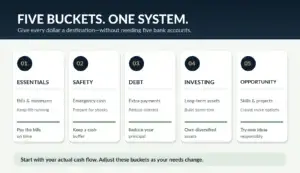
Bucket 1: Essentials — Protect Your Foundation
Your essentials bucket handles expenses you must pay to keep your household and obligations current: housing, utilities, basic groceries, transportation, insurance, and minimum payments on all debts. This is also where predictable monthly commitments belong.
Start with your actual take-home income, not your gross salary. List the due date and amount of every necessary bill. If you have irregular income, build your essential-spending plan around a conservative, reliable baseline rather than your best month.
The goal: Know exactly what it costs to run your life. If essentials consume nearly your entire paycheck, focus first on increasing your margin—through expense reductions, additional income, or both—rather than forcing an unrealistic savings percentage.
Bucket 2: Safety — Create Room for the Unexpected
Your safety bucket exists so a car repair, medical bill, job interruption, or broken appliance does not immediately become a new debt problem. It includes a starter emergency reserve and, over time, a larger cushion based on your household risks. You can also create separate sinking funds for predictable but irregular costs such as insurance deductibles, annual fees, or home maintenance.
The Consumer Financial Protection Bureau recommends a dedicated emergency fund and points to recurring transfers as one of the simplest ways to establish a consistent savings habit.
Keep money intended for near-term emergencies accessible and relatively stable, rather than exposing it to market volatility. When using a bank savings account, verify that the institution is insured and that your balances fall within the relevant FDIC coverage rules.
The goal: Make a surprise expense an inconvenience, not a financial crisis.
Bucket 3: Debt Reduction — Stop Paying for Yesterday
Debt can quietly compete with your future. While all required minimum payments are already covered in Essentials, this third bucket is for extra principal payments that reduce balances faster—particularly on expensive debt.
Two common methods work for different personalities. With the debt avalanche, you direct extra payments to the highest-interest debt first, which generally minimizes interest cost. With the debt snowball, you target the smallest balance first, building momentum as accounts are paid off. The CFPB explains both strategies.
Whichever method you choose, keep making the minimum payments on every account. Review the interest rates, penalties, and any prepayment terms before directing extra cash.
The goal: Free future income from past borrowing decisions.
Bucket 4: Investing — Turn Income Into Ownership
Saving protects what you have. Investing aims to grow what you own over longer periods. Depending on your circumstances, this bucket might include a workplace retirement plan, an IRA, or a taxable brokerage account.
For long-term investments, focus first on your time horizon, risk tolerance, account fees, and diversification—not on trying to predict the next stock that will double. As Investor.gov explains, spreading investments across assets can help manage risk, though it cannot eliminate losses.
Automation makes this easier. A scheduled contribution after each payday can turn investing from an occasional decision into a repeatable habit. If your employer offers a retirement contribution match, understand its rules when deciding how to prioritize your money.
The goal: Build assets that can support your future instead of relying solely on your next paycheck.

A financial routine only works if it fits how you actually earn, spend, and save.
Bucket 5: Opportunity — Fund Your Next Chapter
This is the bucket that many budgets overlook. It is money set aside for opportunities that could expand your earning power or improve your life: a professional certification, business equipment, a carefully researched side venture, a real estate reserve, or the seed capital for a future acquisition.
An opportunity fund is not a license to chase every trending investment or business idea. Its purpose is to let you evaluate promising opportunities without raiding your emergency fund or relying on high-interest credit.
Think in stages: learn, test at a small scale, measure actual demand, and only then commit additional money. A $300 experiment that teaches you what customers will buy may be more valuable than a $3,000 launch built on assumptions.
The goal: Create options so you are not limited to one income source or one path forward.
What Could This Look Like on a $4,000 Monthly Take-Home Income?
There is no universal allocation that works for everyone. But a hypothetical example can make the system easier to visualize. Assume monthly take-home income is $4,000, including enough income to meet every required payment.
Bucket Monthly amount Share
Essentials, including debt minimums $2,400 60%
Safety and cash reserves $400 10%
Extra debt payoff $400 10%
Long-term investing $600 15%
Opportunity fund $200 5%
Total $4,000 100%
This is an illustration, not a recommended allocation for every reader. Someone carrying high-interest credit card balances may put more toward debt. Someone without an emergency reserve may temporarily prioritize cash. When a debt is paid off, that freed-up payment can be redirected to investing or another goal.
How to Automate the System Without Overcomplicating It
1. Choose one landing account. Let your paycheck arrive in your main checking account.
2. Reserve the amount needed for bills. Keep upcoming obligations and minimum payments funded before moving money elsewhere.
3. Schedule small transfers. Route amounts to emergency savings, debt payoff, investing, and the opportunity fund after payday.
4. Leave a checking buffer. Avoid timing transfers so tightly that a delayed paycheck or early bill creates an overdraft.
5. Review monthly. Adjust transfer amounts when income, expenses, or priorities change.
These buckets can be tracked through a budgeting spreadsheet or even subcategories inside a single savings account. The system should simplify your financial life, not create five more apps you have to maintain.
Your 30-Day Wealth System Setup Plan
Week 1: Understand your cash flow
Gather a month or two of transactions, list take-home income and required expenses, and write down every debt balance, minimum payment, and interest rate. Identify the money that is truly available after obligations.
Week 2: Choose your priorities
Set a starting target for your cash cushion, choose a debt strategy if needed, and define one longer-term investment goal. Decide what your opportunity fund will be used for instead of leaving it as an undefined pile of money.
Week 3: Automate one step at a time
Start with a manageable recurring transfer. Add other transfers only after verifying your checking balance can support them. You can always increase the amounts as your margin improves.
Week 4: Review and refine
Did any transfers create stress? Did an unexpected bill reveal an overlooked expense? Make adjustments. The first month is a test run, not a pass-or-fail exam.
Three Mistakes That Can Derail the Plan
- Obsessing over percentages: An idealized allocation is useless if it does not match real-life obligations. Start with dollars, then refine the ratios.
- Investing money you may need soon: Short-term obligations and emergency reserves deserve a different risk profile from long-term investments.
- Never redirecting freed-up cash: A raise or a paid-off loan creates new capacity. Give that money a new assignment before lifestyle inflation absorbs it.
Frequently Asked Questions
Do I really need five bank accounts?
No. Five buckets are five jobs, not five institutions. Some people prefer separate savings accounts, while others track their goals inside a budget or spreadsheet.
Should I invest while I am paying off debt?
The answer depends on interest rates, required payments, employer benefits, available cash reserves, and your goals. High-interest debt can be particularly costly, while employer retirement matches may also have value. Compare the trade-offs rather than following a one-size-fits-all rule.
What if my income changes every month?
Use a conservative baseline for essentials and automate only what you can reliably support. During stronger months, distribute extra cash according to your current priorities.
The Bottom Line: Build a System, Not Just a Budget
Financial progress does not require perfection. It requires enough structure that good decisions happen more often than bad ones. Essentials keep you grounded. Safety gives you breathing room. Debt reduction creates capacity. Investing builds ownership. Opportunity gives you room to grow.
Start today: Pick the bucket that needs the most attention and give it one concrete action—perhaps a $25 automatic transfer, a debt-rate review, or a new savings goal. Small systems can create meaningful results when you use them consistently.
At The Wealthy Way, the goal is not simply to earn more money. It is to use your money to build more choices.
Editorial note: This article is for general educational purposes only and is not individualized financial, investment, tax, or legal advice. Investment values can fall, and financial decisions depend on your circumstances.